Insurance companies and financial institutions run on documents. Policies, claims, invoices, contracts, transaction records, customer correspondence. The work is highly structured and rules-based, which means it should move fast. In practice, it rarely does.
Most of this work still flows through manual steps. Someone opens a document, reads it, types the relevant data into a system, cross-references it against another record, sends a templated email, and moves on to the next one. Any single transaction takes only a few minutes. But multiply that across thousands per month, and you have entire teams whose days consist of repetitive data processing that looks exactly the same from one task to the next.
The direct cost is obvious: staff time. The indirect costs are what really accumulate. Slow turnaround frustrates customers. Manual data entry introduces errors that create compliance headaches down the line. Experienced professionals spend most of their day on administrative processing and a fraction of it on the judgment calls they were actually hired to make.
In 2026, with AI capable of handling structured, rules-based work at scale, that tradeoff no longer makes sense.
Claims Intake And Validation
A single insurance claim can involve a dozen documents. Claim forms, police reports, medical records, repair estimates, photographs, policy details. They arrive in different formats through different channels. Email attachments, scanned paper, uploaded PDFs, photos taken on a phone.
In a manual workflow, someone opens each document, reads it, identifies what type it is, and enters the relevant information into the system. Then they pull up the policy, check whether the claim falls within coverage, look for anything unusual, and compile a summary for the adjuster. That process repeats for every single claim, every single day.
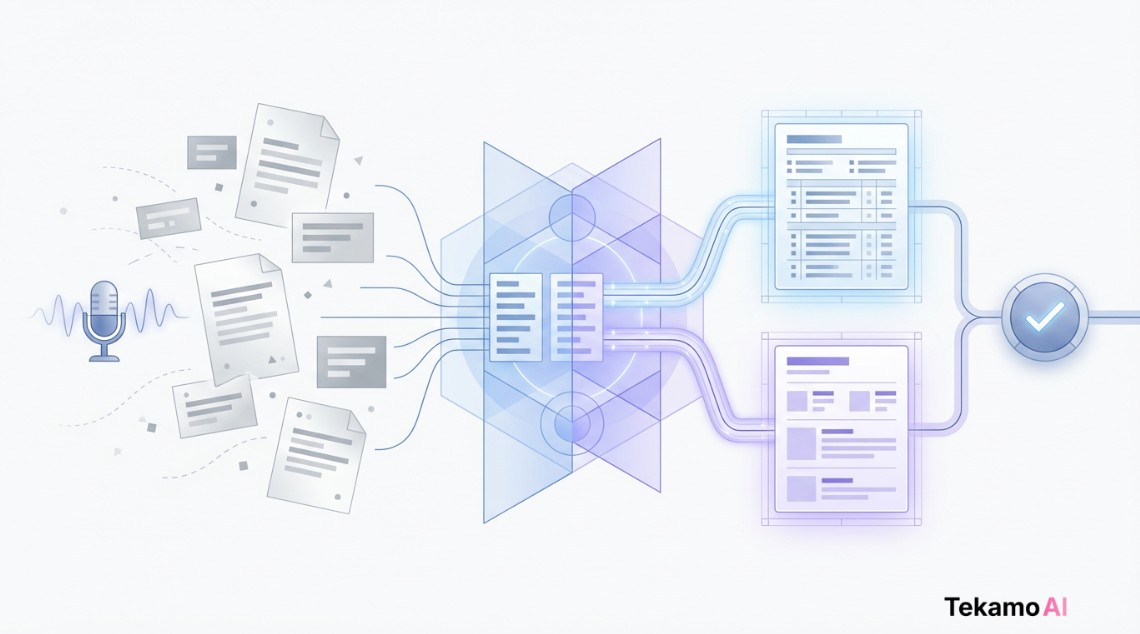
TekamoAI automates the heavy lifting in that chain. Incoming documents are classified automatically. Data is extracted from each one regardless of format. Policy details are cross-referenced against the claim. Inconsistencies, missing information, or patterns that need closer attention are flagged before a human ever looks at the file.
The result is that straightforward claims move through the pipeline in hours. The adjuster receives a structured, verified summary and their job becomes reviewing and approving rather than assembling. Routine cases no longer sit in the same queue as complex ones. And complex claims get more attention because the people evaluating them are not buried under a mountain of standard processing.
Policy And Document Processing
Claims get the most attention, but they are only one piece of the document workload. New policies, renewals, amendments, endorsements, cancellations. Each one generates its own trail of paperwork, verification steps, and data entry.
A new client onboarding might involve collecting identification documents, verifying information against external databases, generating the policy document, setting up payment schedules, and sending confirmation correspondence. A renewal requires reviewing updated information, adjusting terms if needed, generating new documentation, and processing the payment. Every step is predictable and repetitive.
AI handles the document reading, data extraction, and validation across all of these workflows. Documents are routed automatically based on type and content. Data is checked for completeness and consistency before it reaches a human reviewer. What used to take days of back-and-forth processing happens in a fraction of the time.
For companies handling hundreds or thousands of policy transactions per month, the time savings compound quickly. Staff who previously spent their days on data entry and document management can shift their focus to client relationships and exception handling.
Transaction Classification And Reconciliation
On the financial operations side, the volume challenge looks different but the underlying problem is the same. Payments coming in, payouts going out, premium collections, adjustments, refunds, chargebacks. Every transaction needs to be classified, matched against an expected entry, and reconciled.
Most finance teams do this work in spreadsheets or legacy systems that require significant manual input. Someone reviews each transaction, determines what category it belongs to, matches it against the corresponding record, and investigates anything that does not line up. At month-end, this becomes an all-hands exercise that consumes days.
TekamoAI classifies transactions automatically based on established rules and historical patterns. Matching happens in real time against expected entries. Discrepancies are flagged immediately rather than discovered during a monthly reconciliation cycle.
Finance teams stop spending their time on the 95% of transactions that process cleanly and focus their energy on the 5% that actually need investigation. Month-end closes faster. Discrepancies are caught earlier. And the risk of something slipping through unnoticed drops significantly.
Customer Communication That Keeps Up With The Workflow
Every claim, every policy change, every transaction generates a series of communications:
- Acknowledgment of receipt
- Requests for additional documentation
- Status updates
- Final confirmations
Most of these messages are templated and predictable, yet someone still has to trigger each one at the right moment.
When processing is manual, communication often falls behind. A customer submits a claim and hears nothing for days. They call in, wait on hold, and ask for an update that someone has to look up manually. That experience erodes trust, and trust is the foundation of the entire insurance and financial services relationship.
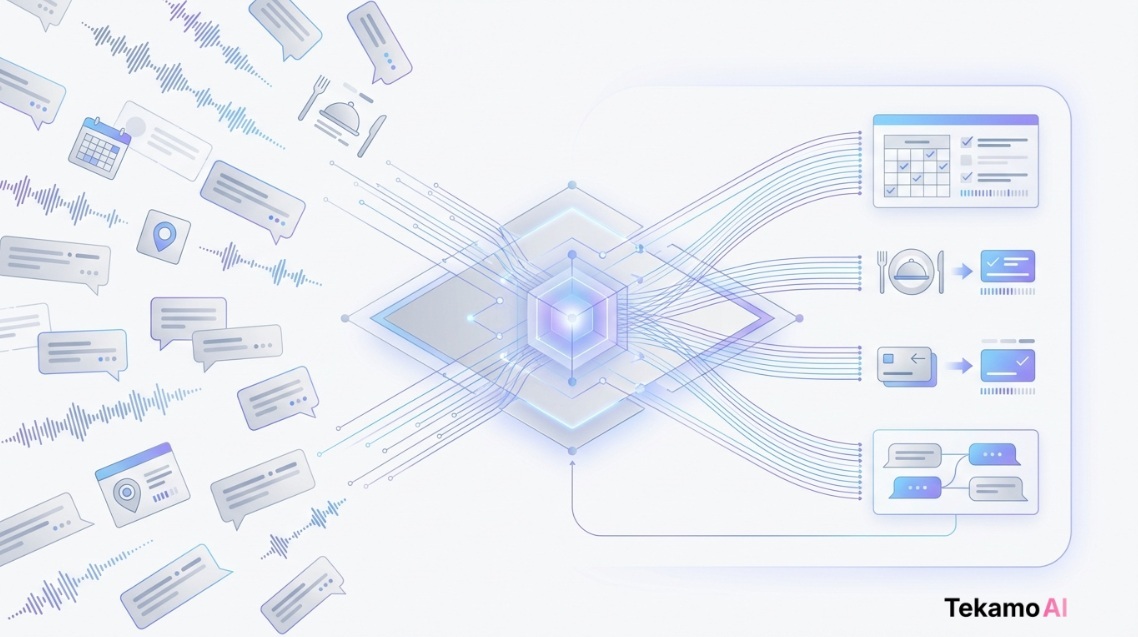
TekamoAI automates the full communication flow. The moment a document is received, the customer gets an acknowledgment. If something is missing, the system requests it automatically. Status updates go out at each stage of processing. The customer always knows where things stand without picking up the phone.
This works across email, chat, and WhatsApp, meeting customers on the channels they already use. The communication stays consistent, timely, and accurate regardless of how many claims or transactions are in the pipeline.
Compliance Without Extra Effort
In financial services, documentation and auditability are not nice-to-haves. Regulators expect complete records of what was processed, when, how, and by whom.
When processing is manual, compliance depends on people following procedures correctly every single time. Across thousands of transactions, with different team members, at different times of day, that consistency is almost impossible to guarantee.
AI-driven processing creates a complete audit trail by default. Every document received, every data point extracted, every validation check performed, every action taken is logged automatically. Rules are applied the same way across every transaction, every time, regardless of volume or staffing levels.
All processing is GDPR compliant with encryption at every stage. Client data is never shared with third parties and never used for AI model training. For companies operating across multiple jurisdictions, the system adapts to regional compliance requirements without requiring separate manual workflows for each market.
What The Numbers Look Like
Companies that automate high-volume financial workflows typically see 20 to 40% fewer operational delays across their processing pipelines. Routine transactions and claims move 30 to 50% faster from intake to completion.
Error rates drop because data extraction and validation happen systematically rather than depending on manual attention. Rework decreases. Customer satisfaction improves because turnaround times shrink and communication stays consistent.
The capacity impact is equally significant. Existing teams handle higher volumes without additional hiring. Senior staff spend their time on evaluation, risk assessment, and client relationships rather than data entry. The expertise you are already paying for actually gets used for what it is worth.
Starting With One Workflow
Transforming an entire operation overnight is neither realistic nor necessary. Most companies start with one high-volume workflow. Claims intake is a common starting point because the volume is high, the process is well-defined, and the results are easy to measure.
TekamoAI configures around your existing systems, document formats, policy structures, and compliance requirements. The first automated workflow can be running within weeks. From there, expansion into policy processing, transaction reconciliation, or customer communication follows naturally based on what the data shows.
Letting Your People Do What They Are Good At
The most valuable people in insurance and financial services are the ones making decisions. Evaluating risk, managing client relationships, spotting opportunities, solving problems that require experience and judgment.
Every hour those people spend opening PDFs, retyping data, and sending templated emails is an hour of expertise applied to work that a system can handle faster and more accurately. In 2026, that is a cost no company needs to keep paying.
If your team is processing more paperwork than making decisions, we would be happy to show you where to start

Book a Demo
See how TekamoAI automates workflows, enhances decision-making, and adapts to your business processes.
Our team will walk you through how TekamoAI integrates with your existing systems, identifies automation opportunities, and delivers secure AI agents tailored to your operations. Tell us a bit about your organization and we’ll prepare a personalized demo that matches your goals and challenges.